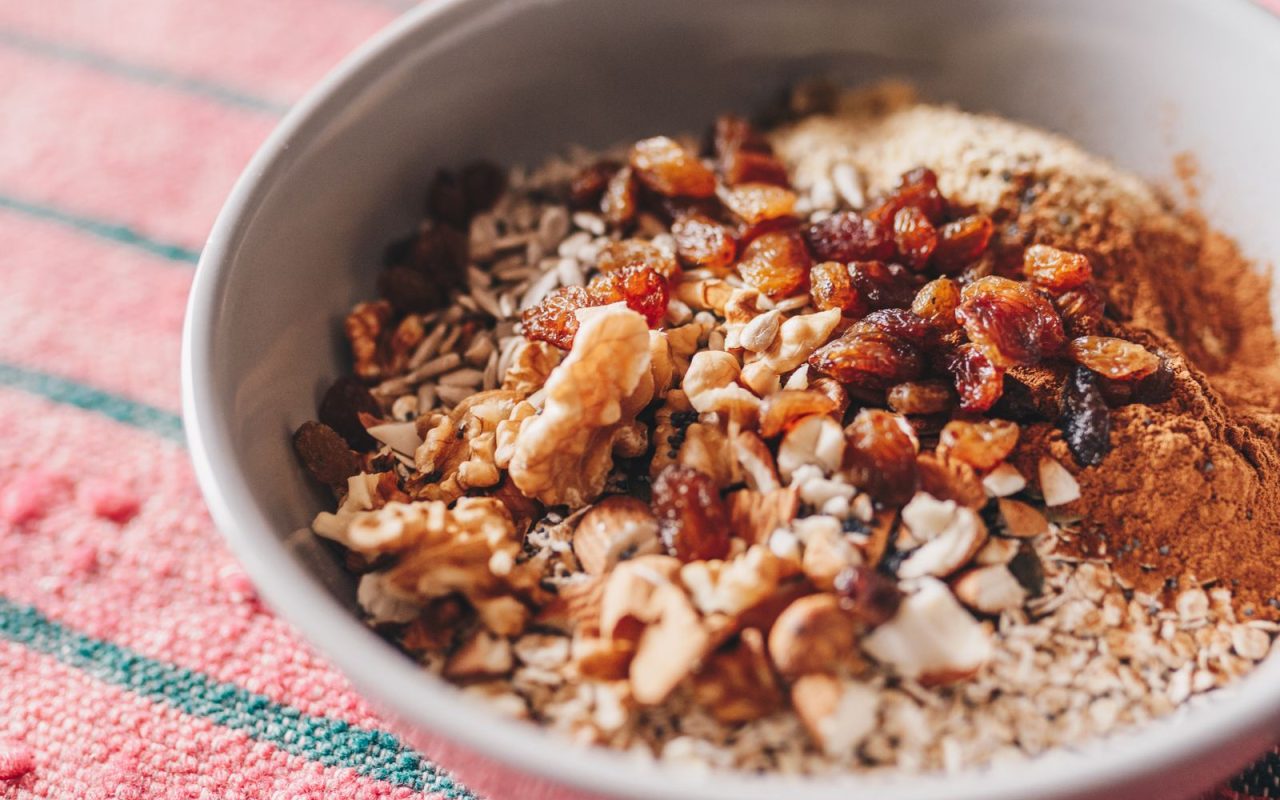
For cereal: the American Diabetes Association suggests whole grain cereals with at least 3 grams of fiber per serving — and a widely used rule of thumb adds under 6 grams of sugar per serving. That one rule eliminates most of the cereal aisle. The safest picks are minimally processed whole grains — steel-cut or rolled oats, plain bran cereals, barley, buckwheat.
For nuts: almost all plain, unsalted nuts are fine, and pistachios have the strongest research signal of the group. But be honest about the size of the effect — when researchers pooled all the nut trials together, they found no significant change in fasting glucose overall. Nuts help most when they replace something starchy, not when you add them on top. 🥜
- The two-number rule that sorts the whole aisle
- Why the same oat can act like two different foods
- Cereals that usually pass the test
- Cereals that usually fail (including “healthy” ones)
- What you put on top matters as much as the cereal
- What the nut research actually shows
- The best nuts for diabetes, compared
- How to eat nuts without cancelling out the benefit
- Building a real bowl: three worked examples
- Seven common mistakes and the fix for each
- Pro tips most articles skip
- Frequently asked questions
- Your shelf-side checklist
The two-number rule that sorts the whole aisle
Standing in the cereal aisle with diabetes feels like taking a test nobody taught you to study for. Every box shouts something — heart healthy, whole grain, made with real fruit, no high-fructose corn syrup. None of those phrases are regulated in a way that tells you what the food will do to your blood sugar.
So ignore the front of the box completely. Turn it around. Picking a cereal comes down to two numbers on the Nutrition Facts panel — the first from American Diabetes Association guidance, the second a widely used rule of thumb:
- Fiber: 3 grams or more per serving. Fiber is the part of the carbohydrate your body doesn’t break down into glucose. More of it means the starch alongside it digests more slowly and hits your bloodstream more gently.
- Sugar: under 6 grams per serving. That’s a teaspoon and a half. Plenty of cereals marketed to health-conscious shoppers carry three or four times that.
That’s it. Two numbers, ten seconds, and you’ve just eliminated somewhere around three-quarters of the aisle. The ADA also frames fiber generally as: 2.5–4.9 g per serving is a “good source,” and 5 g or more is an “excellent source.” For the whole day, the target is roughly 25 to 30 grams of fiber — and most American adults land nowhere near that.
The serving size itself. A box that shows 3 g fiber and 5 g sugar looks great — until you notice the serving is ¾ cup and you habitually pour close to two cups. Everything on that panel scales with what actually lands in your bowl. Measure your normal pour once, with a measuring cup, and compare. Most people are shocked.
Two numbers won’t make you a dietitian. But they turn an overwhelming wall of boxes into a short list, and a short list is something you can actually work with on a Tuesday evening when you’re tired and just want breakfast sorted.
Why the same oat can act like two different foods
Here’s the part that surprises almost everyone: oats and oats are not the same thing.
Glycemic index (GI) is a lab measure of how quickly a food raises blood glucose compared with pure glucose, which is set at 100. Anything 55 or below is considered low. And when you look up oats, you find wildly different numbers depending on which kind you mean.
Typical published values put steel-cut oats around 42 — comfortably low. Instant oatmeal lands somewhere around 79 to 83 — high. Same grain. Same field, potentially. Nearly forty GI points apart.
The difference is entirely how much the factory did to the grain before you got it. Steel-cut oats are the whole oat groat chopped into a couple of pieces. Your digestive enzymes have to work their way in from the outside, and that takes time. Instant oats have been rolled paper-thin, pre-cooked, dried, and often chopped finer still. By the time it reaches you, most of the physical work of digestion is already done — your body just finishes the job in a rush.
Processing is a form of pre-digestion. The more a factory does to a grain, the less work your body has left to do — and the faster the glucose arrives.
The same principle explains the rest of the cereal aisle. Extrusion and puffing — the processes that turn grain into light, crispy, shelf-stable shapes — blow apart the starch structure. That’s why puffed and flaked cereals sit so high on the GI scale, even ones made from whole grain. The grain may be whole on the ingredient list, but its structure is gone.
Published GI values come from small groups of test subjects, and the same food can test differently between labs, brands, and even crop batches. More importantly, your personal response can differ substantially from the published average — the same bowl that barely moves your neighbour can spike you. Use GI to narrow your choices. Use your own meter to decide.
Cereals that usually pass the test
Here’s how common breakfast cereals stack up. GI figures are typical published values and will vary by brand and preparation.
| Cereal | Typical GI | Why it lands there | Verdict |
|---|---|---|---|
| Steel-cut oats | ~42 | Whole groat, barely processed; enzymes work slowly from the outside in | ✅ Best pick |
| All-bran style cereals | ~42 | Very high insoluble fiber physically slows starch digestion | ✅ Best pick |
| Rolled (old-fashioned) oats | ~55 or below | Flattened but not pre-cooked; middle ground | ✅ Good |
| Bran flakes | ~74 | Good fiber, but flaking and toasting undo much of the advantage | ⚠️ Portion carefully |
| Instant oatmeal | ~79–83 | Pre-cooked and thin; flavoured sachets often add 10–12 g sugar | ❌ Usually skip |
| Corn flakes | ~81 | Milled, cooked, flaked, toasted — almost nothing slowing it down | ❌ Usually skip |
| Puffed rice | ~82 | Puffing shatters the starch structure completely | ❌ Usually skip |
The ADA’s general steer on breakfast grains is to build around whole grains: oatmeal, barley, brown rice, wild rice, buckwheat, millet, or rye. Notice how many of those aren’t cereal-box products at all. Hot cereal made from rolled or steel-cut oats is specifically called out as high in fiber and low GI.
The unglamorous winners
Steel-cut oats are the reigning champion, and their one real drawback is time — 20 to 30 minutes on the stove. The fix is batch cooking. Make five days’ worth on Sunday in one pot, portion it into containers, refrigerate, and microwave with a splash of milk each morning. Sixty seconds on a weekday.
Plain bran cereals are the other strong performer, and they’re strong for a different reason: sheer insoluble fiber volume. They will never be described as delicious. But they’re cheap, shelf-stable, need no cooking, and often deliver 8 to 10 g of fiber in a small serving — a meaningful chunk of that 25–30 g daily target before you’ve even left the house.
Muesli (the unsweetened kind, not toasted granola) deserves a mention. Rolled oats, nuts, and seeds with no added sugar and no toasting-in-oil step. Check the panel — a lot of products sold as muesli are granola wearing a different hat.
Cereals that usually fail (including “healthy” ones)
The obvious offenders don’t need explaining. Frosted, honey-coated, marshmallow-bearing, chocolate-flavoured — you already know.
The ones worth naming are the cereals that have built a reputation for being good for you and don’t hold up to the two-number test:
- Granola. Almost universally the highest-sugar item in the healthy-breakfast section. Oats bound together with honey, maple syrup, or brown rice syrup, then baked in oil. Many brands run 12–15 g sugar per small serving, and the serving is often just ⅓ cup. It’s a dessert topping that got promoted.
- Flavoured instant oatmeal sachets. The oats are already high-GI from processing, and then the maple-brown-sugar or apple-cinnamon versions add sugar on top. Plain sachets are better, but still nowhere near steel-cut.
- “Made with whole grain” flakes and squares. The whole grain claim can be true while the product is still extruded into a shape that digests fast, with sugar added for palatability. Whole grain on the front, 12 g sugar on the back.
- Fruit-and-yogurt clusters. The “yogurt” coating is typically sugar, oil, and a little milk powder. The dried fruit is concentrated sugar. Two of the highest-sugar ingredients in the aisle, marketed as the wholesome option.
- Puffed cereals sweetened with fruit juice concentrate. Juice concentrate is sugar. It reads better on a label; it behaves the same in your bloodstream.
Skip the cereal aisle entirely and shop the baking and bulk aisles instead. Steel-cut oats, rolled oats, and plain wheat or oat bran live there, cost a fraction per serving, and come with essentially no marketing on the package — because there’s nothing to hide.
What you put on top matters as much as the cereal
You can pass the two-number test and still send your glucose climbing, because the bowl isn’t finished when the cereal goes in.
Milk contributes carbohydrate. A cup of cow’s milk carries roughly 12 g of carbohydrate as lactose — that’s real, and it counts. Unsweetened soy or almond milk carries far less. Neither is “wrong”; you just need to know it’s in the total.
Dried fruit is sugar in a small package. Raisins, dried cranberries, and dried mango have had the water removed, which concentrates everything. A modest handful can carry more sugar than the cereal beneath it. Sweetened dried cranberries usually have sugar added on top of that.
Banana is the most common quiet spike. A large ripe banana carries around 27–30 g of carbohydrate. Berries are the friendlier swap — a half cup of raspberries or blackberries brings sweetness, real fiber, and a fraction of the carbohydrate.
What genuinely helps is adding fat and protein. Both slow gastric emptying, so the carbohydrate arrives more gradually. Which brings us neatly to the second half of this page.
What the nut research actually shows
Search for nuts and diabetes and you’ll find a lot of confident headlines about blood sugar control. The research is more interesting — and more qualified — than those headlines suggest, and you deserve the accurate version.
Here’s what the randomised controlled trials found when researchers pooled them:
Overall, nut consumption did not significantly change fasting glucose when every nut type was analysed together. Meta-analyses covering thousands of participants across trials of almonds, cashews, hazelnuts, mixed nuts, peanuts, pecans, pistachios and walnuts — median duration around three months — did not produce a clear pooled effect on fasting glucose.
Pistachios stood out in individual trials. A randomised crossover trial in people with type 2 diabetes found meaningful decreases in both HbA1c and fasting blood glucose in the pistachio group, although overall changes in blood pressure and inflammation markers were not significant.
Individual nuts showed individual signals. Walnuts, almonds and hazelnuts have each been reported to reduce fasting glucose and HbA1c to varying degrees across trials, with almonds also linked to improved insulin sensitivity and reduced inflammation.
The benefit shows up most clearly when nuts replace something else — usually refined carbohydrate — rather than when they’re added to an existing diet. That reframes the advice completely. “Eat more nuts” is weak guidance. “Swap the crackers for nuts” is the version supported by the evidence.
So why do nuts help at all? Mechanically it’s not mysterious. Nuts are mostly fat, protein and fiber, with very little available carbohydrate — most nuts have a glycemic index close to zero. Eaten alongside carbohydrate, that combination slows digestion and blunts the sharp rise. Eaten instead of carbohydrate, they simply displace glucose that would otherwise have arrived.
None of this makes nuts a treatment. They’re a genuinely good food that fits well into a diabetes eating pattern, with one nut carrying somewhat better evidence than the rest. That’s a useful, honest place to land.
The best nuts for diabetes, compared
All figures are per 1-ounce (28 g) serving of plain, unsalted nuts.
| Nut | 1 oz looks like | Calories | Fiber | Protein | Why choose it |
|---|---|---|---|---|---|
| Pistachios | ~49 kernels | ~155 | 3 g | 6 g | Strongest trial evidence for fasting glucose; the shells slow you down |
| Almonds | ~23 nuts | ~162 | 3 g | 6 g | Well-studied for insulin sensitivity; the easiest to find everywhere |
| Walnuts | ~14 halves | ~185 | 2 g | 4 g | The main plant source of omega-3 ALA; good for a heart-focused pattern |
| Peanuts (a legume) | ~28 nuts | ~160 | 2 g | 7 g | Highest protein, lowest price — the value option |
| Pecans | ~19 halves | ~196 | 3 g | 3 g | Very low carbohydrate, but the most calorie-dense on this list |
Two things stand out. First, the nutritional differences are smaller than the marketing suggests. Every nut here is low-carb, decently high in fiber, and rich in unsaturated fat. If you like walnuts and hate pistachios, eat walnuts — the gap between them is much smaller than the gap between any nut and a handful of pretzels.
Second, the calories are real. Every one of these lands between 155 and 196 calories per ounce, and an ounce is a genuinely modest amount. Which is the whole problem with nuts.
How to eat nuts without cancelling out the benefit
Nuts are the easiest healthy food in the world to overeat. They’re salty or sweet, they require no preparation, they don’t fill you up quickly, and they come in bags designed to be finished. A “handful” for most people is closer to two ounces than one — around 350 calories, which is a meal’s worth of energy consumed standing at the kitchen counter.
Three things that reliably work:
- Portion before you eat, never while you eat. Buy the big bag for the price, then spend twenty minutes once a week filling small containers or snack bags with one ounce each. Decide the amount when you’re not hungry.
- Buy pistachios in the shell. This sounds trivial and isn’t. Shelling forces a pause between each nut, and the growing pile of empty shells gives you a visual record of how much you’ve eaten. Shelled nuts eaten from a bowl leave no evidence behind.
- Weigh an ounce once, so you know what it looks like. Do it a single time on a digital kitchen scale and your eye will be calibrated permanently. Almost everyone’s mental picture of “an ounce of almonds” is too big.
What to avoid on the label
- Honey roasted, praline, candied, yogurt-coated. These have added sugar, sometimes several grams per serving. It’s a confectionery product.
- Heavily salted if you’re managing blood pressure — and many people with type 2 diabetes are. Plain unsalted, or lightly salted, is the safer default.
- Nut butters with added sugar or palm oil. The ingredient list on a good nut butter reads “peanuts” or “peanuts, salt.” Anything longer deserves a look.
Unsalted Pistachios — 1 oz Portion Packs
The nut with the strongest trial signal, in the format that solves the portion problem
If the research points harder at one nut than the others, it’s pistachios — and if one thing derails nut snacking, it’s portion drift. Pre-portioned single-serve packs solve both at once. You get the nut with the best evidence for fasting glucose, in an amount that’s decided before you’re hungry, in a form you can keep in a desk drawer, a car door, or a gym bag for the moment when the alternative would have been a vending machine.
- Look for “unsalted” or “no salt added” on the front — important if you’re also watching blood pressure
- Pre-portioned packs remove the guesswork that makes nuts easy to overeat
- In-shell versions cost less per pound and slow your eating pace naturally
- Check the ingredient list reads simply pistachios — no oils, sugars, or coatings
- Shelf-stable for months, so a bulk buy doesn’t go to waste
Building a real bowl: three worked examples
Rules are easier to follow when you can see them applied. Here are three breakfasts, all built from things sold in a normal supermarket.
The five-minute weekday bowl
Half a cup of cooked steel-cut oats from a batch made on Sunday, reheated with a splash of unsweetened almond milk. Stir in a tablespoon of chopped walnuts and a half cup of raspberries. Cinnamon on top if you like it.
Why it works: low-GI grain as the base, fat and protein from the nuts slowing everything down, and the sweetness comes from berries rather than sugar or dried fruit. It takes about ninety seconds of actual effort.
The no-cooking-at-all bowl
Plain bran cereal — the boring kind — with unsweetened soy milk, a tablespoon of sliced almonds, and a few blackberries. No stove, no prep, no planning.
Why it works: bran cereals deliver a large fiber load in a small volume, and soy milk adds protein without much carbohydrate. This is the bowl for mornings when your standards have collapsed and you still need to eat something reasonable.
Overnight oats, for people who hate mornings
The night before: a third of a cup of rolled oats, a third of a cup of unsweetened milk of your choice, a tablespoon of chia seeds, and a tablespoon of chopped pistachios in a jar. Stir, lid on, refrigerate. In the morning, add berries.
Why it works: soaking softens the oats without cooking them, so they stay closer to their unprocessed state. Chia adds a serious amount of soluble fiber. And it’s ready before you are.
A reader wrote in about her father, who had eaten the same bowl of corn flakes with milk and a sliced banana every morning for thirty years and could not understand why his morning readings were stubbornly high. They changed exactly one thing: corn flakes to rolled oats, banana to raspberries. Same bowl, same spoon, same chair. She reported his post-breakfast numbers looked meaningfully different within a week. One swap. No willpower required, because nothing about the ritual changed.
Seven common mistakes and the fix for each
- Trusting the front of the box. “Whole grain,” “heart healthy” and “made with real fruit” tell you nothing about how a cereal will behave. Fix: turn the box over every single time. Fiber ≥ 3 g, sugar < 6 g.
- Ignoring the serving size. A great panel means nothing if you pour double. Fix: measure your habitual pour once with a measuring cup and adjust from there.
- Treating granola as health food. It’s the highest-sugar item in the aisle in many stores. Fix: if you love the texture, use a tablespoon as a topping on plain oats rather than a bowl as the base.
- Choosing instant oats because “oats are good.” The grain matters less than the processing — roughly 40 GI points separate instant from steel-cut. Fix: batch-cook steel-cut on the weekend, or use overnight oats.
- Adding nuts on top instead of swapping them in. The evidence is strongest when nuts displace refined carbohydrate. Fix: replace the afternoon crackers with the nuts, don’t eat both.
- Eating nuts straight from the bag. Portion drift is the single biggest way nuts backfire. Fix: pre-portion into ounce bags, or buy in-shell.
- Assuming published GI values apply to you. Individual glucose responses vary a lot between people. Fix: use GI to narrow the shortlist, then use your meter to pick the winner.
Pro tips most articles skip
Test the bowl, not the theory. If you have a blood glucose meter, this is the most valuable thing on this page. Check before eating, then again about ninety minutes to two hours after. Do it for two or three different breakfasts. You’ll learn more about your own body in a week than any article can tell you — including this one. Ask your care team what timing and targets make sense for you.
Eat the bowl in a smarter order. Some research suggests eating protein and vegetables before carbohydrate within the same meal produces a lower glucose rise than eating them mixed or in reverse. It costs nothing to try — eat the nuts and berries first, then the cereal.
Cool your oats. When cooked starch cools, some of it converts to resistant starch, which behaves more like fiber than sugar. It’s one reason overnight oats and batch-cooked-then-refrigerated oats may treat you slightly better than a fresh hot bowl.
Don’t drink your fiber away. Orange juice next to a carefully chosen bowl can undo the work. Whole fruit brings fiber; juice has had it removed. Water or unsweetened tea alongside breakfast is the free win.
Salt matters more than you’d think. High blood pressure and type 2 diabetes travel together often. Choosing unsalted nuts is a small decision that quietly helps a second condition you may also be managing.
Frequently asked questions
Can people with diabetes eat cereal at all?
Yes — the question is which cereal and how much. Cereal is carbohydrate, and carbohydrate is part of most eating patterns for people with diabetes. What matters is choosing a minimally processed, high-fiber, low-sugar option, keeping the portion honest, and pairing it with protein and fat. A bowl of steel-cut oats with nuts and berries is a very different food from a bowl of frosted flakes, even though both are “cereal.”
What is the single best cereal for diabetes?
If forced to pick one: steel-cut oats. It has a low glycemic index of roughly 42, meaningful fiber, no added sugar, and it’s cheap. The main obstacle is cooking time, which batch cooking solves. Plain bran cereals are a close second and need no cooking at all. Neither is exciting, and that’s rather the point.
Are nuts really good for blood sugar, or is that overstated?
Somewhat overstated, if we’re honest. When researchers pooled the randomised trials, nuts as a whole did not significantly change fasting glucose. Pistachios specifically did show a significant reduction, and several individual nuts have shown benefits in individual trials. The clearest effect appears when nuts replace refined carbohydrate rather than being added to what you already eat. So: nuts are a genuinely good food and a smart swap, but they aren’t a blood sugar treatment.
How many nuts can I eat in a day?
A standard serving is one ounce — about 23 almonds, 49 pistachio kernels, or 14 walnut halves — carrying roughly 155 to 196 calories. One to two servings a day fits comfortably into most eating patterns, particularly if those nuts are replacing something else rather than adding to the total. Because nuts are calorie-dense and very easy to overeat, portioning in advance matters more than the exact number. Your dietitian can give you a figure tailored to your calorie and carbohydrate targets.
Is peanut butter okay?
Generally yes, provided the ingredient list is short. A good natural peanut butter contains peanuts, and possibly salt. Products with added sugar, molasses, honey, or hydrogenated oils are a different proposition. Two tablespoons is a serving, and it’s an easy one to exceed — the same portion-drift problem as whole nuts, with less friction to slow you down.
Should I worry about the carbs in milk on my cereal?
You should count them, not worry about them. A cup of cow’s milk carries roughly 12 grams of carbohydrate as lactose, which is real and belongs in your total. Unsweetened soy or almond milk carries considerably less if you want the carbohydrate budget for something else. Sweetened plant milks, however, can carry as much sugar as cow’s milk or more — the word “unsweetened” on the carton is the one to look for.
Your shelf-side checklist
- Turn the box over — check fiber ≥ 3 g and sugar < 6 g per serving
- Check the serving size and compare it to what you actually pour
- Choose the least-processed version available — steel-cut over rolled, rolled over instant
- Put back anything described as granola, honey-roasted, frosted, or yogurt-coated
- Swap dried fruit and banana for berries
- Buy plain, unsalted nuts — pistachios if you have no preference
- Pre-portion nuts into 1 oz bags the day you bring them home
- Use nuts to replace a starchy snack, not to add to one
- Aim toward 25–30 g of fiber across the whole day, not just breakfast
- Test two or three different breakfasts with your meter and let your own numbers decide
- Bring the winning bowl to your next appointment and ask your care team what they think
Sources
The studies and official sources behind the figures and findings on this page. Links open the original publication or its PubMed record.
- American Diabetes Association. Types of Carbohydrates.
- Tindall AM, Johnston EA, Kris-Etherton PM, et al. The effect of nuts on markers of glycemic control: a systematic review and meta-analysis of randomized controlled trials. Am J Clin Nutr. 2019;109(2):297-314. PubMed 30722007 · doi:10.1093/ajcn/nqy236
- Parham M, Heidari S, Khorramirad A, et al. Effects of pistachio nut supplementation on blood glucose in patients with type 2 diabetes: a randomized crossover trial. Rev Diabet Stud. 2014;11(2):190-6. PubMed 25396407 · doi:10.1900/RDS.2014.11.190
Affiliate disclosure. Some links on this page are affiliate links. As an Amazon Associate I earn from qualifying purchases. This never affects which products we recommend or what we say about them.